


How to Treat Dark Inner Thighs and Bikini Line on Skin of Colour
Your inner thighs and bikini line are getting darker, and you have tried everything: brightening creams, scrubbing, remedies from social media, and nothing works. Here is why. Dark inner thighs are not one condition. They are five, each one needs a different treatment, and most people are treating the wrong one. One of the five is not a skincare problem at all. It is a medical signal worth taking seriously.
Darkening of the inner thighs and bikini line on skin of colour has five common causes: friction, hair removal, acanthosis nigricans, hormonal melasma, and fragrance from laundry products. Each looks slightly different and needs a different fix, so the first step is identifying which one you have. Most respond to barrier repair plus gentle melanin-blocking actives and the removal of the trigger. One of the five, acanthosis nigricans, is linked to insulin resistance and needs a doctor rather than a serum. And across all of them, the rule on skin of colour is the same: reduce irritation, because irritation is what deposits pigment.
On melanin-rich skin, friction, fragrance and inflammation all do the same thing: they switch on the melanocytes and leave a dark mark. Treat the cause, not just the colour.
Why does this happen on melanin-rich skin?
The inner thigh area is thin, it folds, and it rubs with every step. On Black and brown skin, that friction triggers inflammation, and inflammation tells the melanocytes, the cells that produce pigment, to deposit more melanin into the skin. Melanocytes in skin of colour are larger and more sensitive to inflammation than in lighter skin types, which is why the same friction that does nothing on fair skin can leave a lasting dark mark on melanin-rich skin.
The result is post-inflammatory hyperpigmentation (PIH). It builds slowly over months, and without treatment it can last a year or longer. The key to treating it is identifying which of the five causes is driving yours, because the wrong treatment wastes months.
Cause 1 · Friction
This is the most common cause, from skin rubbing against skin or clothing all day.
Cause 2 · Hair removal
Every razor drag and every wax strip inflames the skin, and on skin of colour that inflammation deposits melanin.
Cause 3 · Acanthosis nigricans, this one needs a doctor
This cause is not a skincare problem, and no brightening product will fix it. Acanthosis nigricans is linked to insulin resistance, where too much circulating insulin activates receptors in the skin and drives pigment. It is more common in Black, Hispanic and South Asian women.
Cause 4 · Hormonal melasma
Oestrogen and progesterone directly stimulate melanocytes, and some women develop a melasma-pattern darkening in the inner thighs and groin, not just on the face.
Cause 5 · Laundry fragrance
This one surprises people. Laundry detergents and fabric softeners leave fragrance residue in tight-fitting clothing, leggings, underwear and bike shorts. That fragrance sits against your inner thighs for hours every day, and for melanin-rich skin it acts as a chronic, low-grade irritant that quietly deposits melanin day after day. You may have removed fragrance from your skincare, but you are still wearing it.
The full routine
Once you know your cause, here is the routine. Screenshot this.
- 1Morning, barrier repair. After showering, apply a ceramide moisturising cream to the inner thighs and bikini line. Ceramides rebuild the skin barrier, which directly reduces how much friction-inflammation reaches your melanocytes. This step is not optional.
- 2Evening, actives. On dry skin, apply a gentle melanin-blocking active such as 10% niacinamide with zinc, then a 2% alpha arbutin. These affordable options are the right place to start.
- 3Two evenings a week, gentle exfoliation. Use a 10% lactic acid, then seal everything in with your ceramide moisturiser so the actives absorb without the skin drying out.
- •For friction PIH, add a silicone-based anti-chafing barrier gel every morning to physically block friction all day.
- •For hair-removal PIH, use single-blade razors only, shave with the grain, and wait 30 minutes after shaving before applying anything. The first product afterwards should be your pigmentation serum, and never anything fragranced.
- •For hormonal melasma, add a fragrance-free mineral SPF50 whenever the area sees sun, because UV accelerates it. The Dr V InZincable SPF50 is a mineral sunscreen made for Black and brown skin, with zero white cast and anti-pigmentation actives built into the formula. It also comes in larger 50ml and 120ml bottles, so you can use the same formula on the body, not just the face.
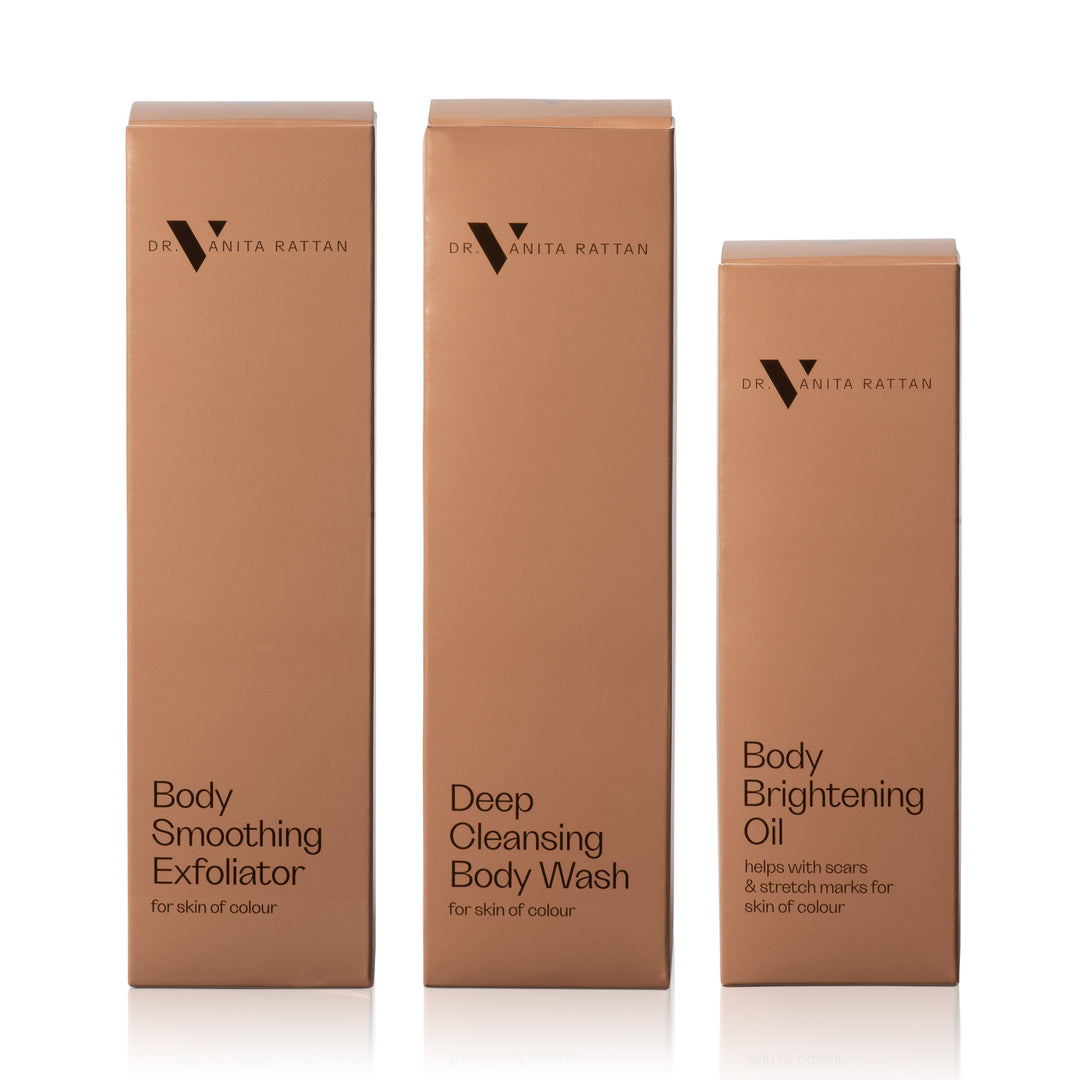
- •For deep, established PIH, give niacinamide a full eight weeks of consistent use before judging it. If the affordable actives are not enough, you can upgrade to the Dr V Body Pigmentation Kit, which combines 10 tyrosinase inhibitors to target melanin from multiple angles and is formulated specifically for body PIH on skin of colour. Start with the affordable products first, and move up to the kit only if you need to.
The one exfoliation rule for skin of colour
There is one rule that matters more than any product choice: no glycolic acid, ever, on this area.
Glycolic acid has the smallest molecular weight of the acids, so it penetrates too fast and too deep on Black and brown skin, and on the delicate inner-thigh area it can trigger the very PIH you are trying to treat.
Use lactic acid instead, ideally in a formula that pairs it with ceramides so it exfoliates and repairs the barrier at the same time. Lactic acid two to three times a week is gentle enough for skin of colour while still resurfacing pigment.
Frequently asked questions
Dark inner thighs are not one problem with one fix. Identify which of the five causes is yours, treat that, repair the barrier, stay consistent for at least eight weeks, and if the skin is velvety and thickened with darkening elsewhere too, see your doctor rather than reaching for another cream.
Dr Vanita Rattan is a medical doctor and cosmetic formulator specialising in skincare for skin of colour. She is the author of Skin Revolution (HarperCollins) and has treated over 40,000 patients with hyperpigmentation. She formulates evidence-based skincare for melanin-rich skin.
 Back to Dr. V's Skin of Colour Blog