


Keratosis Pilaris on Skin of Colour
For skin of colour, the safest approach is to combine controlled chemical exfoliation, consistent moisturising and minimal friction. Avoid aggressive scrubbing, picking and overusing exfoliating acids, as irritation may make the bumps more inflamed and increase the risk of lingering post-inflammatory hyperpigmentation.
Dr Vanita Rattan's guiding principle: "I'd opt for hydration over exfoliation."
This does not mean avoiding exfoliation completely. It means protecting the skin barrier and using exfoliating ingredients carefully rather than trying to scrub the bumps away.
What is keratosis pilaris?
Keratosis pilaris, often called "chicken skin", appears as clusters of small, rough bumps around individual hair follicles. The bumps may be skin-coloured, brown, red or reddish-brown, depending on the person's skin tone and the amount of inflammation present.
KP is caused by keratin building up around the opening of the follicle. It is not an infection, it is not contagious and it is not caused by poor hygiene. (nhs.uk)
It most frequently develops on:
- The backs of the upper arms
- The fronts or sides of the thighs
- The buttocks
- The cheeks
- Occasionally, other areas containing hair follicles
It commonly begins during childhood or adolescence and may become more noticeable when the skin is dry. Although KP can improve over time, it often requires an ongoing maintenance routine rather than a one-off treatment. (AAD)
How does keratosis pilaris look on skin of colour?
On lighter skin, KP is often described as red or pink. On deeper skin tones, however, redness may appear less obvious. The bumps may instead look brown, grey-brown, purple-brown or darker than the surrounding skin.
Inflamed or scratched bumps can also leave post-inflammatory hyperpigmentation, meaning that the roughness may improve before the uneven colour does. Published clinical images demonstrate that KP on Fitzpatrick IV and V skin may appear as hyperpigmented or reddish-brown follicular bumps rather than bright redness. (PubMed Central (PMC))
This is why the treatment goal for melanin-rich skin should not be to exfoliate as strongly as possible. It should be to smooth the follicle while avoiding unnecessary inflammation.
Can keratosis pilaris cause dark marks?
KP itself does not always cause pigmentation. Dark marks are more likely to develop when the bumps become inflamed, scratched, picked or repeatedly rubbed.
The risk may increase when someone:
- Scrubs the area with a rough loofah or body brush
- Picks or squeezes individual bumps
- Uses several strong acids together
- Shaves repeatedly over irritated skin
- Applies fragranced or irritating products to damaged skin
- Uses high-strength home peels without supervision
For pigmentation-prone skin, preventing inflammation is often easier than treating the dark marks left behind.
How should you treat keratosis pilaris on skin of colour?
The most effective home routine combines gentle cleansing, a carefully formulated keratolytic ingredient and regular moisturising.
1. Keep showers short and lukewarm
Very hot water and prolonged bathing may leave dry skin feeling tighter and more irritated. Use lukewarm water, avoid heavily fragranced shower products and pat the skin dry rather than rubbing it vigorously.
Water does not need to "open the pores" for treatment to work. The aim is simply to cleanse the skin without disrupting its protective barrier.
2. Do not scrub the bumps away
Loofahs, abrasive gloves and harsh body scrubs may temporarily make the skin feel smoother because they remove surface cells. However, they do not correct the follicular plugging responsible for KP.
Repeated friction can make the area sore or inflamed. This is particularly unhelpful when the skin is already prone to developing dark marks.
3. Choose controlled chemical exfoliation
Chemical exfoliants help loosen compacted surface cells without the friction created by physical scrubbing.
| Ingredient | How it may help | What to consider |
|---|---|---|
| Salicylic acid | Helps exfoliate inside and around oily follicular openings | Can be drying when overused |
| Lactic acid | Exfoliates while also having humectant properties | Strength and formula influence irritation |
| Urea | Moisturises and softens compacted keratin | Higher strengths may sting damaged skin |
| Gluconolactone | A PHA that provides gentler surface exfoliation | Results may be gradual |
| Glycolic acid | Can improve rough texture | Strong preparations may be too irritating for unsupervised use |
| Physical scrubs | Temporarily remove surface scale | Friction may worsen inflammation |
A four-week clinical study involving 30 adults found that a moisturiser containing 20% urea significantly improved skin smoothness and texture, although the study was small and did not include a control group. (PubMed)
Research also shows that the effect of lactic acid depends on both its concentration and the pH of the completed formulation. This is one reason why judging a product only by the percentage printed on its label can be misleading. (PubMed)
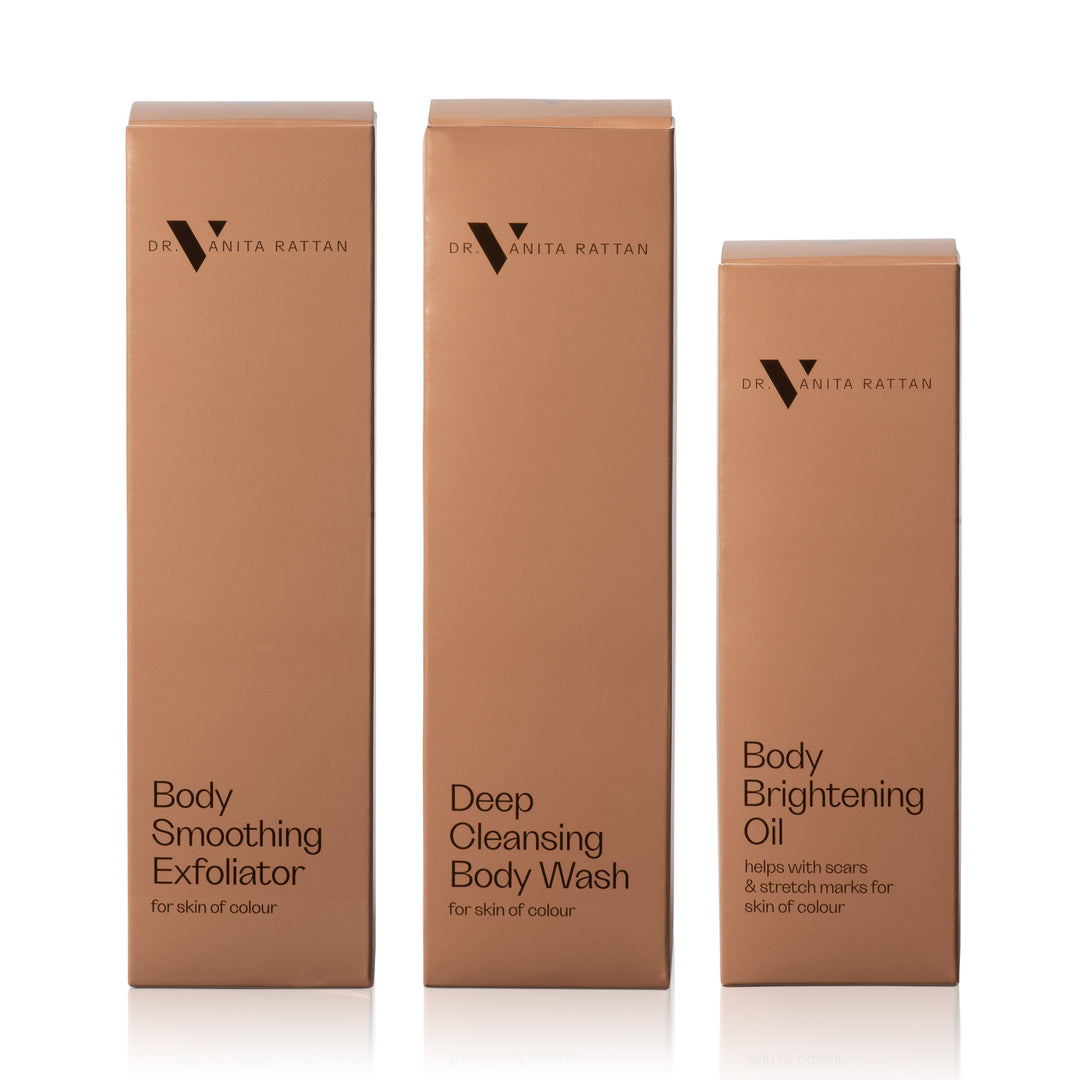
For adults with normal-to-dry, non-sensitive body skin, the Dr Vanita Rattan Body Smoothing Exfoliator provides a measured combination of:
- 4.5% lactic acid
- 0.5% salicylic acid
- Gluconolactone
- Glycerin
- Ceramide NP
- Squalane
- Panthenol and allantoin
The combination is designed to address rough, bumpy texture while including moisturising and barrier-supporting ingredients. The official directions recommend applying it before showering and using it only once or twice weekly.
It should not be used on sensitive, cracked, actively inflamed or eczema-prone skin. The product contains vitamin A and is not suitable during pregnancy or breastfeeding. Follow the product directions rather than leaving it on for longer or using it more frequently in an attempt to accelerate results.
This is a natural product inclusion because the formula reflects the central approach to KP: combine controlled exfoliation with barrier-supportive ingredients rather than relying on aggressive scrubbing.
4. Moisturise consistently
Exfoliation alone is unlikely to produce comfortable, lasting results. A fragrance-free body moisturiser can help reduce roughness, dryness and itching.
Look for ingredients such as:
- Glycerin
- Urea
- Ceramides
- Squalane
- Shea butter
- Dimethicone
- Panthenol
Apply moisturiser after showering while the skin is still slightly damp. The American Academy of Dermatology recommends moisturising soon after bathing and notes that maintenance is generally necessary to keep the bumps controlled. (AAD)
5. Protect exposed areas from sunlight
KP can occur on frequently exposed areas such as the upper arms. Sun protection does not remove the follicular plugs, but it can help prevent existing post-inflammatory marks from becoming more noticeable.
Use broad-spectrum sun protection on exposed skin and avoid deliberately tanning areas affected by pigmentation.
What is a simple routine for keratosis pilaris?
| When | Routine |
|---|---|
| Daily shower | Use lukewarm water and a gentle body cleanser. Do not scrub with a loofah or brush. |
| After showering | Pat dry and apply a fragrance-free moisturiser or oil. |
| Once or twice weekly | Use a carefully formulated body exfoliant according to its directions. Do not combine it with another acid, scrub or retinoid on the same area. |
| On exposed skin | Apply broad-spectrum sunscreen. |
| During irritation | Pause exfoliating products and concentrate on gentle cleansing and moisturising. |
Give a consistent routine approximately four to six weeks before judging whether it is helping. Improvement is usually gradual, and several approaches may need to be tried before finding the right balance. (AAD)
Should AHAs be avoided on skin of colour?
No. A blanket statement that all AHAs must be avoided in skin of colour is not supported by the available evidence.
Lactic acid and glycolic acid can improve surface texture. The concern is not that the ingredient automatically damages melanin-rich skin; it is that an unsuitable concentration, low-pH formula, excessive frequency or combination with other irritants may cause inflammation.
A small study of 25 people found that professionally applied 50% or 70% glycolic acid improved KP roughness and follicular pigmentation in the short term. However, only nine participants were assessed at five years, and their results were no longer significantly different from baseline. This supports cautious expectations: a peel may improve KP temporarily, but it does not establish a permanent cure. (PubMed)
For home use, a lower-strength, well-formulated product used consistently is generally more appropriate than experimenting with high-strength peeling solutions.
Which professional treatments should be approached carefully?
Professional treatments may include chemical peels, laser or light treatments. They should not automatically be described as unsafe, but the practitioner needs experience treating both KP and deeper skin tones.
The main concerns are:
- Excessive inflammation
- Burns
- Post-inflammatory hyperpigmentation
- Uneven lightening or darkening
- Temporary improvement without long-term control
Professional treatment is more reasonable when moisturisers and topical keratolytics have been used consistently without adequate improvement. The AAD notes that lasers may sometimes be considered when moisturisers and medicines are insufficient. (AAD)
Avoid buying high-strength professional peel products online and applying them at home.
What are the biggest mistakes with keratosis pilaris?
The most common mistake is treating KP as dirt or surface build-up that needs to be scrubbed away.
Other frequent mistakes include:
- Exfoliating every day
- Combining acids, scrubs and retinoids
- Picking individual bumps
- Shaving over inflamed skin
- Using very hot water
- Stopping moisturiser as soon as the skin improves
- Expecting permanent results after a short course
- Continuing a product despite burning, swelling or persistent irritation
Slight dryness can occur with some active products, but burning and prolonged inflammation should not be treated as evidence that the formula is "working".
When should you consult a doctor?
Seek professional advice when:
- You are uncertain whether the bumps are KP, acne or folliculitis
- The area becomes painful, hot, swollen or produces pus
- The condition involves the eyebrows or appears to cause scarring
- The skin remains severely itchy or inflamed
- Pigmentation is becoming progressively worse
- A consistent home routine has not helped after several weeks
- You are treating a child or have eczema or another active skin condition
Frequently asked questions
Is keratosis pilaris contagious?
No. KP is not an infection and cannot be passed from one person to another. It results from keratin accumulating around hair follicles.
Is keratosis pilaris caused by poor hygiene?
No. Washing or scrubbing more aggressively will not cure it and may make inflammation worse.
Can keratosis pilaris be cured permanently?
There is currently no consistently effective permanent cure. Treatment helps manage roughness, dryness and discolouration, but maintenance is normally required.
Does salicylic acid help keratosis pilaris?
It may help loosen compacted cells around the follicle. Begin slowly and avoid combining it with multiple exfoliating products on the same area.
Is lactic acid suitable for keratosis pilaris?
Lactic acid can improve surface roughness while also having humectant properties. Its effect and tolerability depend on the complete formulation, including concentration and pH.
Why does my keratosis pilaris look darker after scratching?
Scratching creates additional inflammation. In pigmentation-prone skin, inflammation can stimulate excess melanin production, leaving a darker mark after the bump settles.
Final takeaway
The safest way to manage keratosis pilaris on skin of colour is not to attack the bumps aggressively. Use gentle cleansing, moisturise consistently and introduce a carefully formulated exfoliant slowly.
The goal is smoother skin without creating the irritation that can leave more noticeable pigmentation than the original bumps.
Dr Vanita Rattan is a doctor, cosmetic formulator and author of Skin Revolution with HarperCollins. She specialises in skincare for melanin-rich skin and founded her brand to create evidence-led products for Black and brown skin tones. Her work focuses on common concerns in skin of colour, including hyperpigmentation, post-inflammatory pigmentation, melasma, uneven tone, and barrier health.
 Back to Dr. V's Skin of Colour Blog