


Is Retinol Safe for Skin of Colour? How to Use It Without Worsening Hyperpigmentation
The main concern is not retinol itself, it is irritation. When skin of colour becomes inflamed, it may respond by producing excess melanin, leaving post-inflammatory hyperpigmentation. This means stronger formulas, frequent application and complicated active routines are not necessarily better. (PMC)
Yes, retinol can be safe and beneficial for skin of colour when it is introduced gradually and used in a well-formulated routine. It can help improve the appearance of fine lines, uneven texture, acne and post-acne marks. Dr V approach is simple: choose a lower-strength, non-irritating vitamin A formula, support the skin barrier and build up usage gradually.
What is retinol?
Retinol is a form of vitamin A used in skincare to support skin-cell renewal and collagen production. Once applied, it must be converted within the skin before it can act in its active form.
Retinol is often described as an exfoliant, but it does not work in the same way as an exfoliating acid. It does not directly remove dead skin cells. Instead, it increases skin-cell turnover, helping newer cells reach the surface more efficiently. This can improve the appearance of uneven texture, pigmentation and fine lines over time.
Retinol belongs to the wider retinoid family:
Retinaldehyde occupies a useful middle ground between traditional cosmetic retinol and prescription retinoids. Published research describes it as a well-tolerated and effective cosmetic retinoid. (PubMed)
Why can retinol be more complicated for skin of colour?
People of every skin tone can experience dryness, flaking, redness or stinging after starting a retinoid. The additional consideration for Black and Brown skin is that irritation may trigger lingering dark marks.
Post-inflammatory hyperpigmentation is more common and can be more persistent in darker skin tones. Retinoid dermatitis, the redness, dryness and inflammation caused by using too much too quickly, may therefore leave pigmentation that lasts longer than the initial irritation. (PubMed)
This does not mean that skin of colour should avoid retinol. It means your routine should be designed to prevent irritation before it happens.
Dr Vanita Rattan uses lower percentages of retinol alongside retinaldehyde rather than relying on a high-strength retinol formula. The aim is to deliver vitamin A benefits while minimising the irritation that can worsen pigmentation.
What are the benefits of retinol for skin of colour?
Topical retinoids help keep pores clear and are widely used to manage blackheads, whiteheads and inflammatory acne. Clinical reviews support their use in patients with skin of colour, particularly when acne and the dark marks it leaves behind are treated together. (PMC)
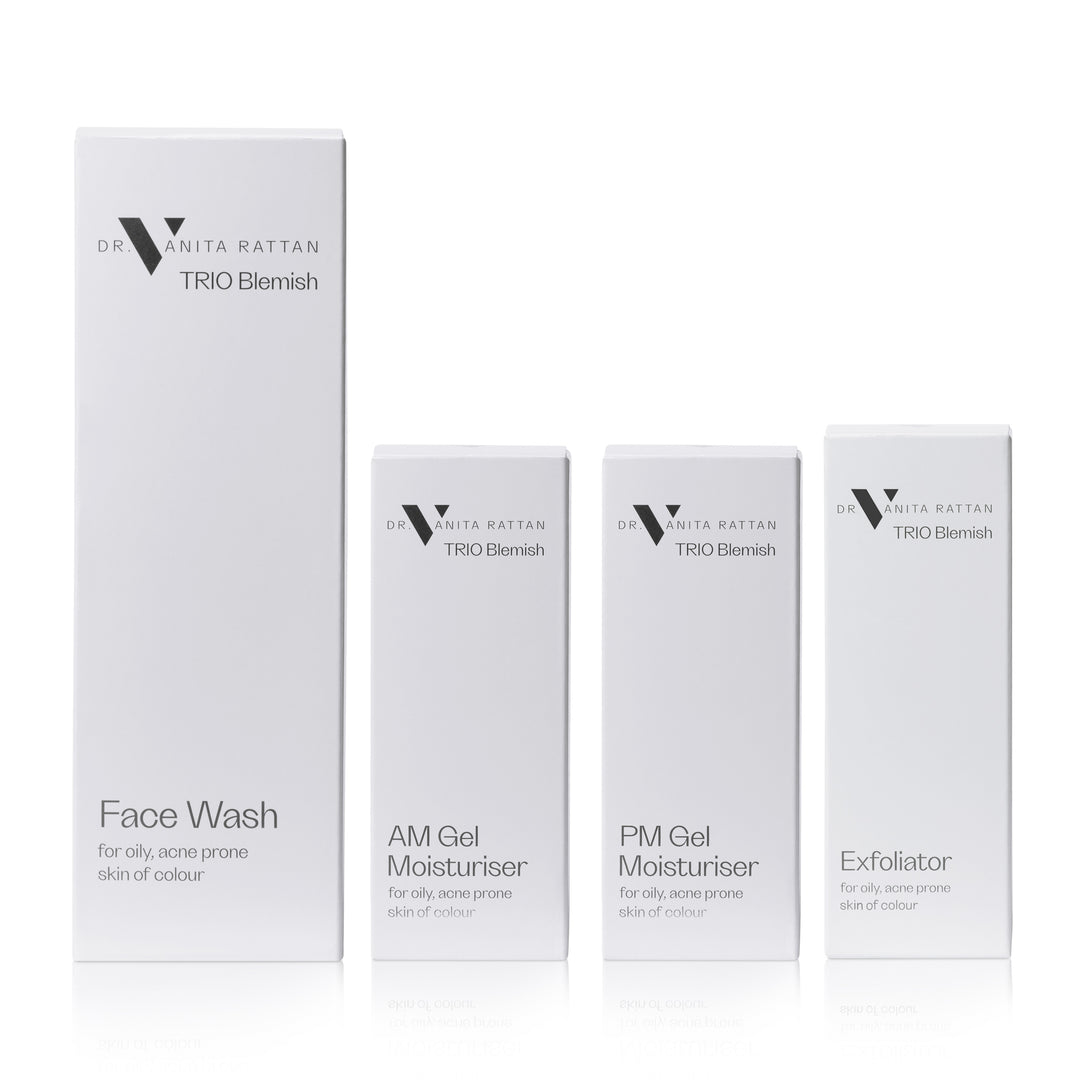
For oily, acne-prone skin, TRIO Blemish PM Gel Moisturiser combines 0.1% retinol and 0.1% retinaldehyde with niacinamide, vitamin C and glycerin.
The lightweight, oil-free evening moisturiser is designed to support acne-prone skin while improving the appearance of post-acne red and brown marks. Introduce it gradually over two to three weeks and do not apply it to damaged or overly sensitive skin.
Retinoids can support a more even-looking complexion by increasing skin-cell turnover and helping disperse excess pigment.
A 2024 systematic review of treatments for post-inflammatory hyperpigmentation in skin of colour found that topical retinoids were among the treatments associated with improvements in pigmentation. (PMC)
However, the balance matters: a retinoid may help fade existing marks, but irritation from overusing it may create new ones.
Vitamin A ingredients are commonly used to support collagen and improve the appearance of fine lines, rough texture and premature ageing.
Results require consistent use over time rather than repeatedly switching to stronger products. (PMC)
Can retinol make skin darker?
Retinol does not directly make melanin-rich skin darker. However, irritation caused by retinol can lead to post-inflammatory hyperpigmentation.
Signs that your routine may be too strong include:
A small amount of temporary dryness may occur when introducing a vitamin A product. Persistent inflammation, pain or increasing pigmentation should not be treated as proof that the product is “working”.
Reduce usage or discontinue the product if irritation develops. Seek advice from your doctor or dermatologist if the reaction is significant or does not settle.
How do you choose a retinol product for skin of colour?
Do not assume a higher percentage is better
A high percentage may look more impressive on the packaging, but it is only helpful when your skin can tolerate it consistently.
For pigmentation-prone skin, a gentler formula used regularly may be more useful than a stronger product that repeatedly damages the skin barrier.
Check the whole formula
Retinol should not be assessed by percentage alone. Look for supportive ingredients such as:
Dr V also recommends avoiding denatured alcohol, fragrance and essential oils where possible, particularly if your skin is sensitive or pigmentation-prone.
Look at the packaging
Vitamin A can become less stable when repeatedly exposed to light and air. Opaque, airless packaging can therefore help protect the formula after opening.
This is why the Antioxidant Power Serum is packaged in an opaque, airless pump.
It combines:
The formula is also free from denatured alcohol, fragrance and essential oils to minimise potential irritation.
Choose a formula for your skin type
Oily and acne-prone skin may prefer a lightweight, non-comedogenic gel or serum. Normal, dry or combination skin may benefit from a formula containing more hydrating and barrier-supporting ingredients.
If your skin is very dry, damaged or actively inflamed, focus on repairing the skin barrier before introducing retinol.
How should you introduce retinol into your routine?
- 1. Patch test first. Apply a small amount to a discreet area and monitor the skin before using the product across your face. Patch testing cannot predict every possible reaction, but it may help identify obvious sensitivity.
- 2. Begin gradually. Do not start with nightly application simply because the label permits daily use. A cautious introductory schedule is: week one, apply once; week two, apply twice; week three, apply three times. Continue increasing only if your skin remains comfortable. Always follow the directions provided with your specific product.
- 3. Use the recommended amount. Applying more retinol will not produce proportionally faster results. It is more likely to increase dryness and irritation. A pea-sized amount is usually sufficient for the face unless the individual product directions state otherwise. Dot the product around the face before gently spreading it into a thin, even layer. Avoid the corners of the nose, lips and other areas that become irritated easily unless the formula is specifically designed for them.
- 4. Apply retinol at night. Retinol is best used as part of an evening routine. If you have worn makeup or water-resistant sunscreen, cleanse thoroughly first. Apply the vitamin A product according to its instructions, then follow with a moisturiser if required.
- 5. Support your skin barrier. Use a gentle cleanser and a moisturiser containing hydrating and barrier-supporting ingredients. Applying moisturiser before and after a retinoid, sometimes called the sandwich method, may help sensitive skin tolerate it more comfortably. (American Academy of Dermatology) Ingredients such as glycerin, ceramides, peptides and niacinamide can help support hydration and the skin barrier while using retinol.
- 6. Keep the rest of your routine simple. When you first introduce retinol, avoid using several strong active ingredients on the same night. Dr V recommends using high-strength glycolic acid, strong exfoliating treatments and low-pH ascorbic acid on separate nights from retinol, particularly when the skin is sensitive or pigmentation-prone. Combining retinol with prescription retinoids, strong exfoliating acids or multiple resurfacing treatments may increase irritation. Introduce one new active at a time so that you can identify the cause if your skin reacts.
- 7. Use sun protection every morning. Sun protection is essential when treating acne marks, uneven tone or premature ageing. Choose a broad-spectrum sunscreen and apply it consistently each morning.
What should you do if retinol irritates your skin?
Stop or reduce usage if you experience significant redness, soreness, burning or peeling.
Use a gentle cleanser and a rich, fragrance-free moisturiser until the skin barrier has recovered. Do not attempt to treat the reaction by applying more acids or additional active ingredients.
Once the skin feels comfortable again, restart slowly with a smaller amount or less frequent application.
Seek advice from your doctor or dermatologist if the reaction is painful, severe or does not settle.
Who should avoid retinol?
Avoid retinol or seek professional guidance before using it when:
Retinoids should be avoided during pregnancy. Follow the individual product guidance regarding breastfeeding and speak to your doctor when unsure. (American Academy of Dermatology)
Frequently asked questions
Retinol is not automatically unsuitable for skin of colour. It can be a valuable ingredient for acne, post-acne marks, uneven texture and visible signs of ageing.
The key is to avoid the common “stronger is better” approach. Choose a thoughtfully formulated product, start slowly, apply only the recommended amount, moisturise well and stop if your skin becomes persistently inflamed. For melanin-rich skin, preventing irritation is part of preventing pigmentation.
Dr Vanita Rattan is a doctor, cosmetic formulator and author of Skin Revolution with HarperCollins. She specialises in skincare for melanin-rich skin and founded Skincare by Dr V to create evidence-led products for Black and brown skin tones. Her work focuses on common concerns in skin of colour, including hyperpigmentation, post-inflammatory pigmentation, melasma, uneven tone, and barrier health.
 Back to Dr. V's Skin of Colour Blog